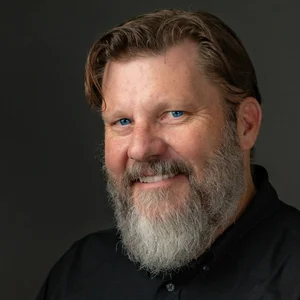
What the Desert Knows
Fine Art Landscape Photography at Canyonlands National Park
By Eric O. Ledermann
I wasn't looking for anything. I'm just drawn to the wilderness — to the desert in particular.
All I planned was to go to Canyonlands National Park. That's what I told myself. I always bring my camera. I pack my camera bag first, before my clothes. Charge the batteries. Clean the lenses. And then the 6.5 hour drive to Monticello, Utah. It's another hour to the Needles District entrance to Canyonlands.
What I didn't plan for was the six miles of trail that took two hours to drive because the terrain was so precarious. I had to watch every rock, every drop, every impossible angle of approach, not to mention a few sheer cliff edges to the so-called trail. What I didn't plan for was what happens when I'm forced — by bad road and sheer necessity — to slow all the way down, 2 to 5 miles per hour at best. Coming out of the Visitor's Center there is a road to the left that is paved, and a road to the right that is dirt with warning signs: "High Clearance 4 wheel drive vehicles required." I chose to go right.
At first a false sense of security washes over me as the road is easy. Further in, the road turns from a shallow layer of soft silt to hard rock formations that cause my truck to twist and creak.
I won't detail it here, but it's been a hard season for me. There are seasons of life that feel like a landscape you didn't choose and can't quite read — where you're not sure if you're lost or just in unfamiliar terrain, where the road ahead isn't clear, and where the question you keep turning to is whether you should keep moving forward or try to turn around and go back to the safety of the Visitor's Center. It's a question of whether any of this really matters. Whether you matter. Whether what remains of you, after everything, is enough.
I drove into the desert with all of that packed alongside the camera gear and clothes. And the desert, which doesn't care about any of it, proceeded to tell me exactly what I needed to hear.
Still Here
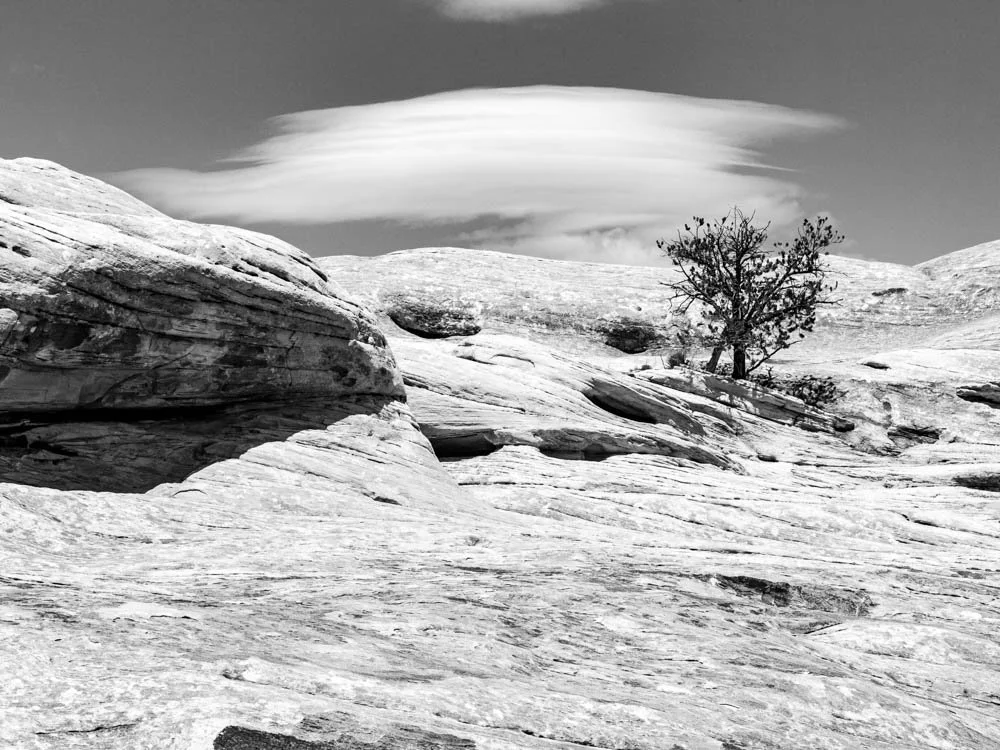
Still Here — A solitary Utah Juniper clings to bare slickrock, defying every reason not to exist — no soil, no water, no shelter — beneath a lenticular cloud that offers the shape of rain without the promise of it. Needles District, Canyonlands National Park, Utah — June 19, 2026. © Eric O. Ledermann Photography. All right reserved.
Walking back to my truck, still in the parking lot of the Needles Visitor Center, I looked up at a bare stone hillside and saw a small bush standing alone. Not a remarkable bush by most measures. Small. Sparse. A Utah Juniper growing from what appears to be nothing — bare slickrock, no visible soil, no apparent source of water. Above it, a lenticular cloud hung in the sky like a taunt — the shape of rain, the promise of rain, absolutely not rain. The sky was nearly empty. The stone was barren. And this shrub was there anyway.
I couldn't get closer because of the brush at the base of the hill. But the sight of this small shrub all by itself captured my focus in a way I could not understand in the moment. In the deep recesses of my mind I knew what I was seeing before I raised the camera.
I was seeing myself.
Small and struggling but still here. Even if barely. Even on bare rock with no apparent reason for optimism, no visible source of sustenance, mocked by a sky that offers the shape of relief without delivering it. Still here.
The black and white rendering of this image does something the color version cannot. It strips away the pretty — the blue sky, the warm sandstone tones, the green hints of life in the juniper's sparse canopy — and leaves only the essential: form, texture, endurance. The bush against the stone against the sky. The question this image asks is not isn't this beautiful? It's how is this possible?
I don't have an answer. I just know the bush is there. Existing. And so am I.
Even Here
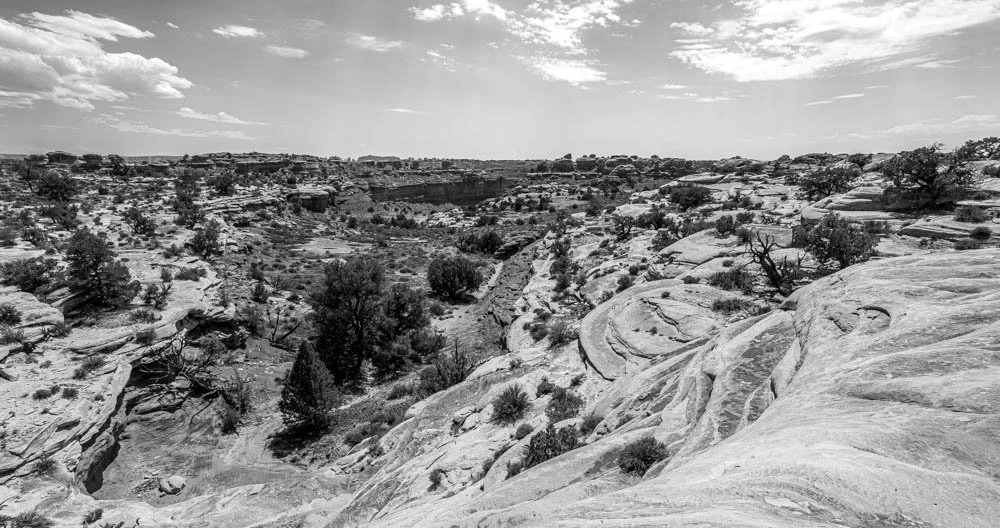
Even Here —In a landscape that seems empty, life insists on itself — juniper and scrub finding purchase in the cracks of an ancient canyon that stretches beyond what any single frame can hold. Needles District, Canyonlands National Park, Utah — June 19, 2026. © Eric O. Ledermann Photography. All right reserved.
From a small bush on a barren slickrock hillside, to the vast expanse of the canyons. There's a particular feeling that comes from standing at the edge of something too large to hold in a single frame.
I stood above a canyon in the Needles District and tried anyway. My 17-40mm lens at its widest couldn't contain it. The canyon just keeps going — layers of geology laid down over hundreds of millions of years, eroded into improbable forms, stretching toward a horizon that seems to recede as I get closer.
What struck me wasn't the grandeur, though the grandeur was undeniable. What struck me was that even here — in what should be the most barren, inhospitable, empty landscape imaginable — there was life. Juniper trees finding purchase in cracks. Scrub brush in the dry washes. Green insisting on itself in the dry red, grey, and brown earth.
Even here.
I think about the hard seasons — mine, and those I've witnessed in the people I've walked alongside through decades of pastoral work. The seasons that feel like standing at the edge of something too vast to comprehend, with no singular focal point, nowhere to rest the eye. Just immensity in every direction and the uncomfortable question of what to do with it.
The answer the desert offers is not resolution. It's not a focal point to organize the chaos. It's just this: even here, there is life. Even in what feels mostly barren, mostly rocks, mostly inhospitable — life emerges and persists. Life quietly makes itself known.
This image, I should warn you, might frustrate some. If you're looking for something to focus on, you won't find it. The canyon is the subject. The immensity is the point. If your eye wants to move on quickly — I understand. At first glance it looks uninteresting. But I invite you to stay a moment longer than feels comfortable. Let the vastness do what vastness does.
That discomfort is the beginning of something.
It Matters
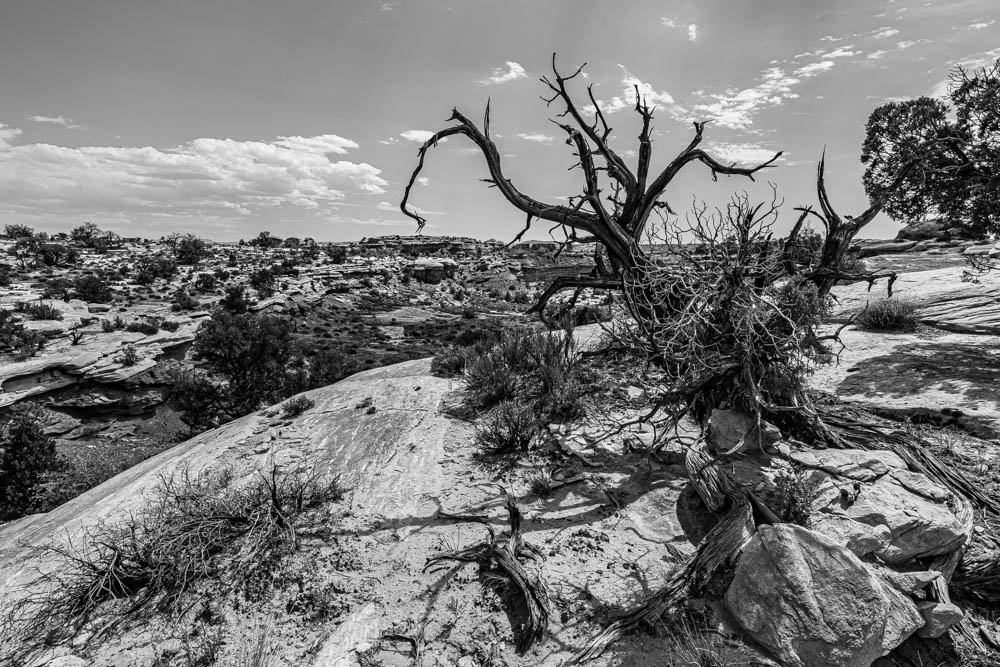
It Matters — A dead Utah Juniper, frozen mid-reach after a tumultuous life on bare rock, still shapes the view — because the lives that have ended never stop mattering. Needles District, Canyonlands National Park, Utah — June 19, 2026. © Eric O. Ledermann Photography. All rights reserved.
I saw this tree from about fifteen feet above, from the top of a sandstone formation. Something about this dead tree stopped me. The way it is frozen in time, reaching for something. The way its limbs went in every direction as though it had spent its entire life fighting something — wind, drought, time itself. A gnarly, twisted, dramatic shape that spoke of a tumultuous life. And now, at the end of that life, it stood stripped bare on an open rock face above the expanse of the canyon, still reaching.
I climbed down to reach it. I got as low as I could, pressed against the rock behind me because there was nowhere to back up. I made the frame from that position, looking up at what remained.
I found myself asking a question I wasn't expecting.
Why should this one tree matter?
It lived its difficult life on a bare rock in the middle of a vast wilderness that no one visits, except by the occasional four-wheel-drive vehicle. It took two hours to drive the six miles to get to the remnants of this tree. It struggled and bent and reached and persisted. And now it's dead. And behind it stretches the immensity of the canyon — indifferent, ancient, continuing without it.
Why should this one tree matter?
I don't think the question is really about the tree.
I think it's about whether any individual life — yours, mine, or anyone else's — matters in the face of such immensity. Whether the struggle and the tumult and the particular shape this difficult life gives us counts for anything. Whether what remains after the hard seasons still has meaning.
I don't have a clear universal answer. But I believe the question is sacred. And I believe that tree matters, whether or not the universe does. Not mattered — matters. Present tense. The tree is dead and it still shapes the view. Its bleached form alters the landscape around it. The shadow it casts, the way it interrupts the skyline, the space its absence of leaves creates against the canyon behind it — all of that is present tense activity. The tree is still doing something.
When people we love die, they don't stop mattering. They become part of the landscape of our existence. They shape the view. They interrupt our skyline. They are present in the space they left behind.
Witness is a form of insistence. To photograph something is to say: this existed, and it matters that it existed.
That's at least partly why I love photography. And mostly why I photograph people.
Immensity
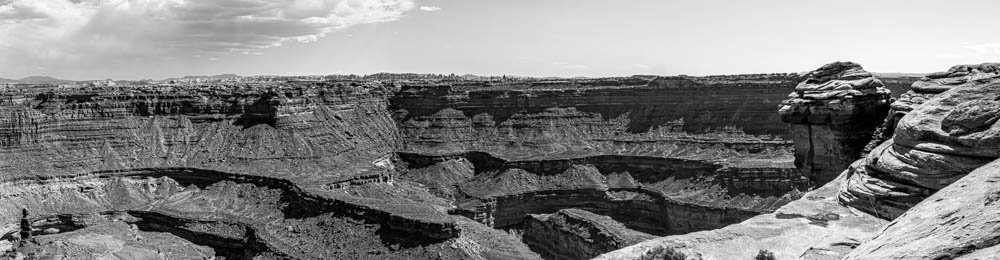
Immensity — Three frames stitched into one still cannot contain it — a canyon carved by hundreds of millions of years of geology, indifferent and overwhelming, inviting the eye to stop searching for a subject and simply stay. This image best viewed large, at last 6 or 7 feet wide. Needles District, Canyonlands National Park, Utah — June 19, 2026. © Eric O. Ledermann Photography. All rights reserved.
This image is three photographs stitched together because even at 17mm wide — the widest lens I own — I could not contain what I was seeing in a single frame.
I wish you could see this image large on a wall somewhere. A gallery perhaps. Very large. Seventy, eighty inches wide if possible. Because the whole point of this image is scale, and scale cannot be communicated on your small screen.
If you were to see it large, I believe something would happen. Once again there is no focal point. There is no single subject. Your eye enters the frame and has nowhere to land — it keeps moving, keeps searching, keeps finding more canyon, more layers, more rocks and seeming emptiness.
In a gallery, most people, I suspect, would gloss over this image quickly because there is nothing to grab onto. That impulse — to move on because there is no convenient focal point — is, at least in part, what this image is about.
How much of life do we gloss over because it doesn't organize itself around a single interesting subject? How much immensity do we miss because we're looking for the thing to focus on and can't see that the whole landscape is the thing? We want the tree, the dramatic dead juniper, the road leading somewhere. We want a subject. And sometimes life refuses to provide one. Sometimes the canyon itself is the story, and we have to learn to stay with that.
This image makes me feel small — not unlike photographs of the Milky Way from here on Earth. Genuinely small. Yet not insignificant — small the way I feel small standing at the ocean, which is a feeling that paradoxically makes me feel more alive rather than less. The immensity doesn't erase me. It just puts me in proportion.
I needed that. More than I knew.
From Death to Horizon
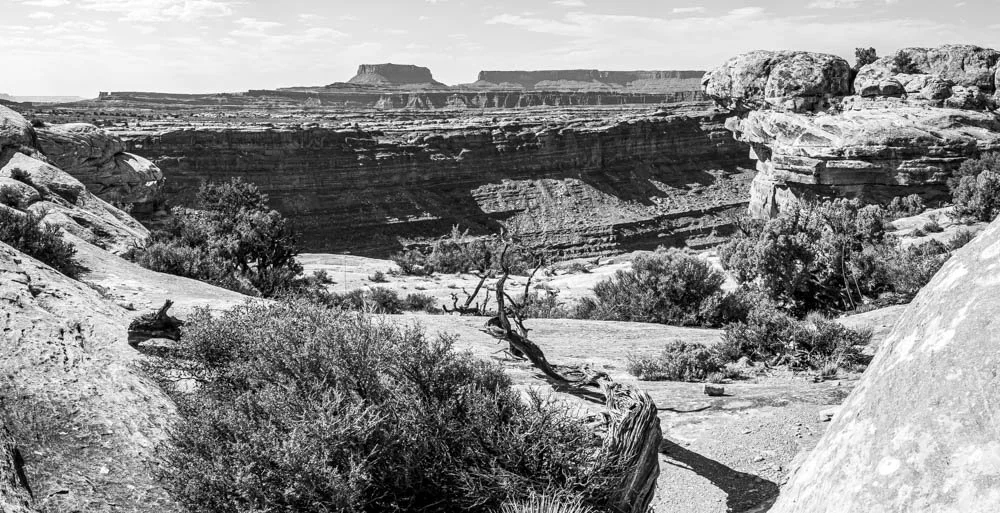
From Death to Horizon — The eye travels through time in a single frame — from a bleached log long absent of life, through living sage, across canyon walls laid down over millennia, to a distant mesa that belongs to some other scale of existence entirely. Needles District, Canyonlands National Park, Utah — June 19, 2026. © Eric O. Ledermann Photography. All rights reserved.
This is in the same space as the previous image, at the end of a deceivingly short road — six miles — that took two hours to traverse.
I say that not to impress you but to explain something I came to understand on this pilgrimage to a place I didn't know: by the time I arrived at the overlook where I made this image, I had been forced to be fully present for a very long time. There was no distracted driving on that road. Every rock demanded attention. Every drop required a decision. The terrain would not allow me to be anywhere but exactly where I was.
I wonder sometimes if that's part of what the desert does. It creates conditions that make presence unavoidable. Just about everything can either hurt or kill you, even the hot dry air.
What I re-discovered when I arrived was layers.
In the foreground, a dead log — weathered, twisted, bleached — lying across the slickrock. Behind it, desert sage in silver-green. Behind that, the canyon wall dropping away, and then rising again in stratified red and orange. And in the distance, a flat-topped mesa catching afternoon light against a pale sky.
I know in this black and white image you can't see the color layers. But the drama of black and white takes me from death to horizon, to hope and life moving forward from the far distant past. Color seems to distract the flow.
The eye, if you let it, travels through time in this image. The dead log is immediate — it's right there, though long absent of life. The sage is present tense — alive, fragrant, occupying the middle ground between what has ended and what continues. The canyon wall is geological time — millions of years of accumulation, erosion, transformation. And the mesa at the horizon is almost mythological, the way distant landforms always are, belonging to some other scale of existence entirely.
I like this image for reasons I can't fully articulate. It asks the eye and mind to do work, to move, to travel from near to far, from ended to enduring. It doesn't resolve. It layers.
Most of the meaningful things in life don't resolve either. They layer. They accumulate, collapse, and accumulate some more. They ask you to hold more than one thing at once — death and life, barrenness and fullness, endings and horizons — without demanding that you choose.
What the Desert Can Teach Us
I came to this part of the world in the desolate southern Utah expanse because something draws me. I won't pretend I fully understand the pull — the desert was never where I imagined myself living. But something about this landscape and the people who inhabit it, who think about things differently, who have made peace with the austere and the vast and the ancient — something about that calls to me, and I continue to answer.
What I discovered on this particular day, driving a terrible road into a landscape that couldn't care less about my hard season, is that the desert already knew what I was carrying. Or rather — the desert provided the images I needed to see it more clearly. A struggling tree on bare rock. An immensity that doesn't resolve into something manageable. A dead form that once had a tumultuous life and yet still stands in witness to the life it lived. Layers moving from death toward infinite horizon.
I didn't plan to find any of that. But I've learned to trust that what I find when I'm paying attention is usually what I needed to find.
As I reflected on these images, and what drew me to capture them, I realized something about a completely different genre of photography that also draws me. Every person who sits with me in a portrait session is a landscape. They have their lone juniper — the thing that has persevered against the odds, that grows from bare rock with no apparent reason to still be there. They have their immensity — the interior vastness that most people never see because there's no convenient focal point to organize it around. They have their dead junipers — the tumultuous chapters that ended, the parts of themselves they're not sure still matter, the shapes that difficulty gave them, and the life that continues to grow despite the tumult and little deaths we all experience throughout life.
Everyone has layers. The foreground of what's immediate and present, what they're willing to reveal to others. The middle ground of what's alive and ongoing. The distant horizon of what they're moving toward, even if they can't quite see it yet.
My art — in the desert and in the studio — is about paying attention. Staying long enough. Sometimes getting low, climbing down toward what calls to me, resisting the urge to gloss over the immensity just because it doesn't offer a convenient focal point. To say with my camera: you exist. You matter. I was here, and I saw you.
That's why I create photographs. That's why I photograph people. I needed the desert to remind me.
Eric O. Ledermann is a fine art and portrait photographer based in Chandler, Arizona. His commercial portrait work can be found at ericoledermann.com. His fine art photography lives at terralucida.gallery.
Ready to capture your next portrait or headshot? Let's talk! Schedule a call today or contact me directly at 480.257.6757 (text or call). I’d love to help you bring your photography vision to life!